A Global Perspective
on University Libraries and a Roadmap for
(Draft- 2.0)
21 February 2006
Dr. Javed I. Khan
Fulbright Senior Specialist
Sponsored by Fulbright Scholar Program,
Media Communications and Networking Research Laboratory
Department of Computer Science,
233 MSB,
javed@kent.edu
TABLE OF CONTENT
1 Introduction:
The Waves of Change
2 The
State of Libraries in Bangladesh Universities
2.1 Poor
Collection Getting Poorer
2.2 Vanishing
Journals and Periodicals
2.3 Administrative
Policy Strangulation
2.4 Library
Automation Initiative in the Country
2.5 Failure
Analysis on Past Initiatives Toward Collective Services
3 Overview
of Modern Federated Digital Library
4 Trends
and Issues Facing Western Libraries
4.2 Open
Access Scholarly Publication Movement
4.3 Formation
of Library Alliances
5 The
Idea of Bangladesh Digital Library Consortium (BDLC)
7.2 Library
Automation System Software (LAS)
7.3 Master
Catalogue and Digitization
1
Introduction: The
Waves of Change
Research and Education Networks (REN) established by the universities around the world are now opening up whole new set of possibilities to exploit information technology in higher education [1,4]. Nowhere the benefit of REN is as vivid as it is in the transformation of the libraries and the emergence of digital libraries (DL). The libraries of the world are currently undergoing revolutionary changes [2]. Research library provides two core function- (a) collection and archiving of human knowledge and (b) scholarly communication- dissemination of quality scientific knowledge. Digital technology is transforming both. Grand projects are now underway to digitize all available books that mankind posses. Some estimate as much as 10 million[1] books will be freely available on our desktops in few years. Some of the most valuable resources used to be available only to the limited scholars in the developed world. But now one can ‘scroll’ the intricate details of original Diamond Sutra- which its original printer Wang Jie “reverently made for universal free distribution on behalf of his two parents” in 868 AD, or literally ‘turn’ the pages of Sultan Bayber’s magnificent Quran (digital library of British Library, 2005). Scholarly materials now can be made universally available irrespective of time and distance constraints.
The tree of modern knowledge has transcended into numerous branches of specializations. The area of scholarly communication is now served by a whopping 43,000+ active journals and periodicals [11]. RENs make it possible full-text resources from at least 14,000 of these to be delivered right at the user's desktop in any part of the world in seconds. There is now new tool for indexing, abstracting, cross-referencing. Integrated electronic processing is also being used to dramatically reduce the edit and publishing time.
Potential benefits of digital libraries are more
pronounced for the libraries of the developing countries. An average
|
Table-1 Some |
|||
|
Institution |
Books |
Serials |
DL |
|
|
500,000 |
800 |
Yes |
|
|
700,000 |
n/a |
Yes |
|
Chepauk Library, |
509,263 |
642 |
Yes |
|
|
800,000 |
795 |
Yes |
|
|
442,300 |
N/A |
Yes |
|
LUMS, |
52,000 |
325 |
Yes |
|
|
195,000 |
276 |
Yes |
|
|
400,000 |
970 |
Yes |
|
|
n/a |
n/a |
No |
|
|
n/a |
n/a |
No |
|
|
1,239,749 |
3631 |
Yes |
|
|
X |
x |
x |
|
|
550,000 |
250 |
No |
|
|
182,000 |
200 |
No |
|
Table-2 Potential Participants for BDLC |
|
|
Types |
Institutions |
|
Public Universities [1] |
19 |
|
Private & International Universities [1] |
54 |
|
Public Medical & Dental Colleges [2] |
14 |
|
Private Medical & Dental Colleges |
17 |
|
Open University |
1 |
|
|
1 |
|
Total Conventional
R&D Universities |
106 |
|
|
|
|
Research Institutes/ Centers |
58 |
|
|
3 |
|
ARI Admintrative Centers |
10 |
|
Collections-Major Library (Non-University) |
7 |
|
Collections-Museum |
8 |
|
Other Institutes & Centers |
6 |
|
Total Other
Institutions |
92 |
Given the advantages of federated digital libraries, the
European and
The unprecedented worldwide transformation of the
universities if missed will put the viability of her higher education in doubt.
Particularly in peril is her public education system. Facilitating access to
information, knowledge and learning tools is basic premise behind institutional
learning.
This paper is a sister paper of a proposal for REN [4]. A REN
enables the entire research and education establishment of all disciplines of a
country to come to an even point in technological readiness from where it can
take full advantage of ICT and launch applications such as digital library. The
submarine data cable now creates a new opportunity as well as a new momentum to
revitalize the dilapidated infrastructure of the country’s universities.
Indeed,
This paper presents the proposal. It is a concept paper.
It is not intended to present detail design. It draws upon an in-site situation
survey on the state of higher education conducted in 2005. Section 2 first
presents a stock check on the university libraries of
2
The State of Libraries
2.1 Poor Collection Getting Poorer
Since, the inception of the country in 1971, the libraries of its higher education institutions never got a chance to be in a competitive shape. These are now further deteriorating. Only 6 public universities have 100K+ records (Fig-1 & 2). Private university libraries are essentially empty. Half among the 50+ private universities reported to own just 5000 or less records [7]. Given the young age of these universities one might expect rapid acquisition. Unfortunately, only half reported adding about 1000 books between 2003 and 2004. Just to place the figures in perspective, a typical western university keeps about 4-15 million records. Even a high school library keeps about 20-30,000 records. Only one Dhaka University (DU) has any sizable collection (about 600K records). Yet, about 25-33% of this collection is believed to be antiquated. Most libraries have almost no audio-visual collections- one bothered to report an inventory of one record!
2.2 Vanishing Journals and Periodicals
 The libraries are completely at lost in the
face of journal pricing. The serial unit cost has increased by 188% between
1982 and 2004 at 2.5 times faster than the CPI inflation index. Western
research university libraries kept up by doubling their budget [2]. But, in
The libraries are completely at lost in the
face of journal pricing. The serial unit cost has increased by 188% between
1982 and 2004 at 2.5 times faster than the CPI inflation index. Western
research university libraries kept up by doubling their budget [2]. But, in
2.3 Administrative Policy Strangulation
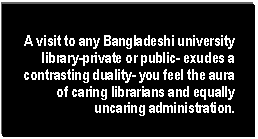
There is apparently no way in sight to shine any hope of reversal. Libraries are also at a point of administrative strangulation. For years, many senior library positions in the universities were left vacant or filled by faculty administrators. It is not hard to see that the issues concerning modernization of libraries have been neglected for years at policy and subsequent funding decisions- both within the university as well as at higher levels. Policy framers play a very important role in multiple levels in the strategic adoption of technology [5]. A visit to any Bangladeshi university library-private or public- exudes a contrasting duality- you feel the aura of very caring librarians and equally uncaring administration. University administrations are in competitive posture rather than in cooperative mode. This is not unexpected given the non-existence of any form of REN network which is essential for university libraries to join hand and benefit from cooperation. There is not adequate training for library professionals. Practically, there is little hope that Bangladeshi libraries will ever be able to recover following the current path. The only hope to restore access might be a rapid development of a digital library.
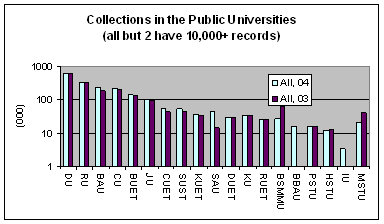
Fig-1
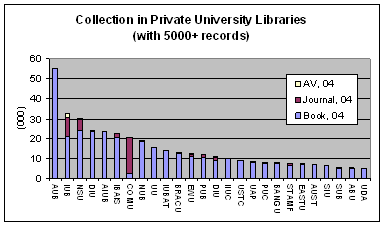
Fig-2
2.4 Library Automation Initiative in the Country
In recent years, several universities have taken disconnected initiatives for library automation systems (LAS). In a 2005 survey, out of 17 public universities 5 and out of 39 private universities 9 responded to have some form of E-library [13]. BUET has just completed the development but yet to lunch. There are few other problems such as lack of standardization work- specially, in the area of handling Bengali records, lack of inter-library exchange, program etc.
2.5 Failure Analysis on Past Initiatives on Collective Services
Since, 1980s’ there have been several attempts by UGC to
unify the library catalogue systems and even to arrange some form of
cooperative journal subscription (Awwal, 2005, UGC Annual Report 2003 [12]). But
it is yet to be realized. It is not hard to apprehend why. The idea to avoid
duplicate subscription was right, but without any REN or a sharing infrastructure/mechanism
between institutions- the circulation actually turns harder. The benefit
remains localized. Naturally, universities did not cooperate among themselves or
with UGC in this model. While library community
and UGC clearly foresaw the need of a digital library- but without REN it
became an attempt to put the cart before the horses. Currently, there is another circulating
proposal (to build e-catalogue for
In 1998, there were a networking attempt called Bangladesh
National Scientific and Technical Library Information Network (BANSLINK). It
ventured to connect libraries across the country by setting up a network with
15 libraries- 6 out of Dhaka and 9 in
However, the organizers of the previous attempts should be considered as valued member in BDLC initiative as there are important lessons to be learned from failures much of which were clearly structural. BLDC will tremendously benefit from the collective experiences.
3
Overview of Modern
Federated Digital Library
A modern federated library is a complex system. Typically, the university’s library automation system running on the REN serves as its front end with a web interface. In backend it is connected to numerous databases- both local and remote. It has several components- the computing and communication infrastructure, various services software, and various content and index (catalogue) databases. It requires an infrastructure network via which students and faculty can access the entire library portal and resources from the library, departmental offices, and dormitories. In the backend the network has to have high performance reach all the way to the content provider systems of the databases. Federated digital library alliances also have started adding their own data centers.
The first step towards a digital library is to have collection which has electronic catalogue and digitized content. Bulk of the pre 1980’s collection requires digitization. However, newer books and articles are now originated in digital forms. A Digital Library points to local and remote collections. A federated library needs to manage federated authentication and access manager middleware on top of the regular network. All systems need to have various sophisticated inter-database record search and matching capabilities.
The main content currently served by DL is journals and periodicals. Besides, there are major collections on art and architecture images, audio recordings, satellite images, maps, social studies related materials, educational videos, foreign language videos, demonstration videos, etc. There are already growing E-book collections of classic books, technical reference books, encyclopedias, handbooks, biographical books, guides, government publications, masters’ theses and doctoral dissertations. Also, a recent trend is to add courseware materials.
 Collections of a DL are offered by (a) full
content from publishers (such as ACM, Elsevier) (b) research databases which
are third party value added secondary and tertiary catalogues, and (c) master
catalogue and contents owned by the member organizations. Historically, most DL
systems started with records of the last type- but increasingly the first two
types of remote resources are becoming the major components of a federated
system. While, many of the databases of the first two categories are now
online, few of these databases may come off-line such as in CD. A modern DL
offers user-initiated and non-mediated online borrowing through the search
portal.
Collections of a DL are offered by (a) full
content from publishers (such as ACM, Elsevier) (b) research databases which
are third party value added secondary and tertiary catalogues, and (c) master
catalogue and contents owned by the member organizations. Historically, most DL
systems started with records of the last type- but increasingly the first two
types of remote resources are becoming the major components of a federated
system. While, many of the databases of the first two categories are now
online, few of these databases may come off-line such as in CD. A modern DL
offers user-initiated and non-mediated online borrowing through the search
portal.
4
Trends and Issues
Facing Western Libraries
4.1 Rising Cost of Journals
The serial unit cost has increased by 188% between 1982 and 2004 at 2.5 times faster than the CPI inflation index. Some top journals are costing 5,000-8,000 US$ for 12 issues. Western universities primarily responded by increasing their serials budget at par with this rise. Few reduced their monograph budget. However, western research university libraries have seen some recent decline in serial per unit cost [2]. It has been attributed to consortia licensing arrangements for electronic journals. In some cases elimination of the print subscription has resulted in reduced fees for the electronic-only version. The libraries are facing a new ‘Big Deal’ challenge from the publishers. Publishers are bundling online subscription so that individual journal subscriptions can no longer be cancelled forcing libraries to subscribe journals they don’t want.
4.2 Open Access Scholarly Publication Movement
Higher education communities worldwide are also searching
for alternate models of publication to fight the rising cost of conventional
journals. For example, SPARC initiative [2] spearheaded by US Association of
Research Libraries (ARL) is encouraging research community based online scholarly
publication where servers are jointly contributed by the universities. In
another effort Higher Education Funding Council for
4.3 Formation of Library Alliances
Western libraries are also forming digital federations. Examples
of advanced
Digital format has been found to substantially reduce the
cost of printing, archiving, and access. A study [3] on eleven
 A typical state-of-the-art federation is OhioLINK.
It is a venture initiated by Ohio Board of Regents (OBR) that funds the
universities of
A typical state-of-the-art federation is OhioLINK.
It is a venture initiated by Ohio Board of Regents (OBR) that funds the
universities of
5
The Idea of Bangladesh
1.
Access to latest scientific
publications has reached almost none in public universities. Universities have dwindling
access to books, journals and periodicals. This is having crippling effect on
the future of national science and technology readiness. A federated digital
library model offers only realistic possibility to reverse the situation. It
will not only restore this access to a respectable size, but make it comparable
to that at developed world.
2.
Vast amount of electronic books, courseware, and
multi-media content are already available via open access. A Digital library
gateway can provide instant access to the students and faculty of
3.
For Bangladesh almost none of the
institutions individually are found to be capable of subscribing major periodical
collections such as IEEE, ACM, or even the supposedly low cost new mode scholarly
publishing (such as the SPARC or Digital Library of Science). But, roughly, any
federation with four members breaks even the cost- a federation with 30 members
will be see about 7-5 times reduction in cost per institution.
4. Some publishers are very large organization. Federation provides better negotiating position to keep the cost under control. Increasingly the publishers are bundling journals as Big Deal. Individual institutions may not find all titles in a bundle useful but a large federation with more research diversity will benefit more from Big Deal.
5. Even free access materials have restrictions such as Creative Comments licensing. Due to complexity of intellectual property laws and their variations across nations many of these collections are reluctant to enter into access contracts with small entities. It is easier to workout access contracts if the universities approach as a federation.
6.
The automation of the libraries will
help in improving other library services including better collection management,
accounting and reduce floor-space usage. Demand and usage can be tracked more
accurately with new tools [14]. Unused periodicals can be unsubscribed.
7. Information property is fast becoming a major commodity in the 21st century. Developing countries may loose squarely rights on its intellectual resources due to digital divide. Locally, originated content, and intellectual properties may have to be bought back.
8. Without a digital publishing and archiving system, researchers from a non publishing country will remain obscure. The problems of the developing world will get lesser importance and lesser recognition in research communities, and there will be lesser efforts to solve them.
DL in
6
A Road Map
6.1 Initiating the Initiative
1.
UGC can start by convening a conference inviting
all the (a) private and public universities, (b) research organizations, (c) academies
and (d) major libraries of
2. Invite participants from the three communities (a) professional librarians (b) interested faculty researchers from information sciences, library sciences, and computer sciences and engineering and related fields, and (c) chief operating officers. Form a steering committee to decide the mission, membership, planning and budgeting.
3.
The next step will be to discuss the concept and
collect letter of interest and initial commitment from interested organization.
With the concept and a unified platform of the higher education of
6.2 Organizing the Consortium
4. Establish key technical committees/working groups in areas including (a) software development (b) standardization & interlibrary cooperation, (c) collective resource procurement, (d) e-catalogue and digitization, (e) publishing and hosting support services (f) user services & training etc. to lead in respective technical areas. Invite past initiators for their experience and involve new bloods for their enthusiasm and new ideas.
5. Initiate signing a memorandum of understanding by members. There should be some commitment such as subscription, library facilitation to make their libraries and campuses DL enabled, providing REN connectivity, adequate access terminals, reading and browsing rooms, adherence to sharing policies.
6.3 Functions and Services
6. Roll out the first version of the digital library. UGC and the members should establish an initial budget and may roll out a very basic web based digital library system with open access and already member subscribed materials.
7. Expand access. Take active initiative to join larger multi-national, regional and trans-continental DL federations as a group to further obtain leverage in gaining access to content.
8.
Expand services. Create a state-of-the-art
online publishing service. It should provide full editorial process management,
publishing, hosting and permanent archiving facility to the journals and
proceedings published by the faculty and researchers of its member organization
and professional organizations in
9. Move for unified cataloguing, digitization and sharing of local content. Establish Inter Library Loan Program (ILLP) to complement the inter library catalogue sharing.
10.
Plan for a
7
Relevant Issues
7.1 Expertise
The technical challenge of DL is substantially different from REN. It would require technical experts in information and library sciences (rather than only pure computer scientists or engineers), and experts in user areas. For example an archeological archive would need archeologists and historians to manage standards for indexing organizing, and maintenance as much it needs a database expert. It will also require permanent professional librarians and ICT engineers in central and member library sites. Training will be very important due to rapidly changing nature of the technology. Provisions have to be built into the budget proposal.
7.2 Library Automation System Software (LAS)
A local team can build a LAS and the web-based DL access
system. There are several free open source DL software developed by UNESCO and
other organizations. However, associated standards for federated access
management, ontology, multi-lingual document management, digital object
exchange, e-commerce, etc., are still actively evolving. Thus,
7.3 Master Catalogue and Digitization
The driving force behind most digital library alliances
was to pool together the materials owned by their members. However, now the remote
digitized materials are the gem attractions. This is particularly the case for
the developing countries. Universities currently have a combined total of 2.2
million records including duplicates [7]- vast more are now accessible and
downloadable remotely. Thus the reality is such that online access system to DL
is strategically much more important than the local electronic catalogues.
7.4 Standardization
The digital library and electronic cataloguing will
require conformance with many interoperability standards if it were to access
worldwide digital resources. A technical committee within the initiative should
familiarize themselves with the ongoing issues with these international
standards such as Dublin Core, IEEE LOM, Open Archives Initiative, TEI, APPM,
AACR2, MARC, ISBD, OWL, etc, and advice the initiative. The body would also
need to take leadership in advancing standards related to Bengali records
including other Bengali language constituencies from
7.5 Indigenous Collection
It will be a timely idea also to simultaneously initiate a digital publication service for scholarly publications of local origin. These have to be done in two forms- one for scholarly articles and another for monographs (books) and special value collections. There is currently no local digital archival and circulation system though there are quite a few journals and regular conferences within the country. An offer to host local academic journals/proceedings by BDLC is expected to be highly appreciated by the editors/organizers. BDLC can also extend this service to offer editorial process management similar to those offered by EDAS® or Manuscript Central®. This will encourage national and international scholarly activity at low cost within the country. The initiative will offer greater global visibility to local scholars and researchers and their research problems and would provide important advantage to retain the intellectual property rights of the local scholars.
8
Acknowledgements
The author would like to
thank Fulbright senior specialist program and the host
9
References
|
[1] |
Kiernan, Vincent, The Next
Information Superhighway -Universities are creating a muscular new computer
network, but it offers more than some want, The Chronicle of Higher
Education, July 2004, Volume 50, Issue 44, Page A29. |
|
[2] |
Martha Kyrillidou and Mark Young, ARL Library Trends, Association of Research Libraries, September 27, 2005, [URL: http://www.arl.org/stats/arlstat/04pub/04intro.html#t2 ] |
|
[3] |
Ann Okerson and Roger C. Schonfeld, Non-subscription costs of print and electronic journals on a life-cycle basis, URL: http://www.ifla.org/IV/ifla70/papers/100e-Okerson_Schonfeld.pdf |
|
[4] |
|
|
[5] |
Betty Collis & Marijk van der Wende, The Use of Information and Communication Technology in Higher Education, An International Orientation on Trends and Issues, A study commissioned by the Dutch Ministry of Economic Affairs and the Ministry of Education, Culture and Science, 1999. |
|
[6] |
Monwar Hossain, Optical Fiber Backbone Links in Bangladesh and their Interconnection with Submarine Cable for Connectivity with World Information Super Highway, Seminar on Fiber Optics Infrastrcture in Bangladesh and Optical Internet, PMO, May 21, 2005. |
|
[7] |
UGC Annual Report 2004, |
|
[8] |
Mlitwa, Nhlanhla, Global Perspectives on Higher Education & the Role of ICT, Cape Higher Education Consortium Conference, University of the Western Cape (UWC), Bellville, South Africa, September, 2005 |
|
[9] |
Beth Elise Whitaker, Association of African Universities Charts Goals for 21st Century, International Higher Education Quaterly, Spring 2001, Boston University. |
|
[10] |
National Information and
Communication Technology Policy 2002, October: 2002, Ministry of Science and
Information & Communication Technology of the People's Republic of |
|
[11] |
Can the OhioLINK Mission Be Fulfilled? Providing for 21st Century
Information Needs, OhioLink Update, v. 11, no2, Sep. 2005 [web http://www.ohiolink.edu/about/
update/ sep2005.pdf] |
|
[12] |
K. M. Abdul Awwal, “ |
|
[13] |
Strategic Plan for Higher Education in Bangladesh Strategic Plan for Higher Education in Bangladesh ICT in Higher Education, Report of Expert Group F (1st Draft), University Grant’s Commission, August, 2005. |
|
[14] |
Colleen Cook, Fred Heath, Bruce Thompson, and Duane Webster, LibQUAL+®: Preliminary Results from 2002, Performance Measurement and Metrics 4, no. 1 (2003): 38-47. For a comprehensive bibliography, see the LibQUAL+ project homepage. |
|
[15] |
Ron Feemster, Volume Discounts: OhioLINK is a purchasing consortium, and a state-of-the-art library system, National CrossTalk, vol. 11, no. 3,, 2003. [http://www.highereducation.org /crosstalk/ ct0303/ news0303-discounts.shtml] |